Tell us about the job
Takes about a minute. No obligation.
A compressor that sat off all winter and fired up for the first time in June may already be failing before summer is half over. Homes in Norfolk County, MA run cooling about two months a year, from July through August. The contactor and the condenser fan carry the same short burst of seasonal load, but they also sit idle long enough for contacts to corrode and capacitors to weaken undetected. When a contractor opens a unit here, the condition they find often reflects months of dormancy as much as the season's actual runtime. A system that gets a pre-season check has its faults caught before the first hot week, when the schedule fills fast.
Ductwork in a house this old has seen more than one cooling system come and go. Half the homes in Norfolk County, Massachusetts were built in 1964 or earlier (2020-2024 ACS 5-year). That history matters to a repair job because the refrigerant lines, the coil mounts, and the air handler connections a contractor finds when the unit comes apart reflect what was put in during the last replacement, not what the house was built with. If that system took a part that is no longer in production, the repair goes in a different direction than a standard fix.
The Parts of a Central AC a Contractor Checks During Repair
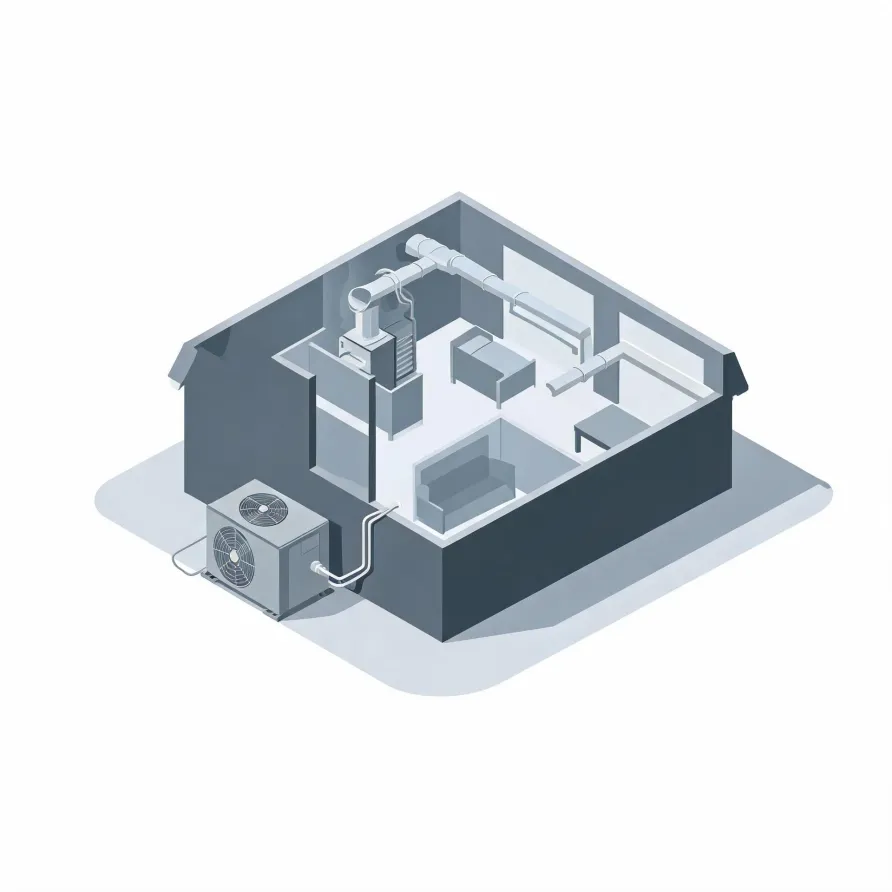
The outdoor condenser unit sits outside the house, usually on a concrete pad along an exterior wall, and houses the compressor and condenser coil. These are the pieces a contractor reaches first. A failed compressor, a refrigerant leak at the coil, or a seized condenser fan motor each produce distinct symptoms, and identifying which one is the source of the problem is where a repair diagnosis begins.
Inside the house, the air handler holds the evaporator coil and the blower fan, typically in a basement, closet, or attic. The expansion valve and the refrigerant lines connecting the two units also fall within a contractor's inspection, since a restriction or a leak anywhere along that path changes how the whole system behaves.
The drawing shows the general layout of a central AC system, and a licensed contractor determines which components and conditions apply to your specific house.
Get matched in Norfolk CountyNorfolk County, by the numbers
595 severe weather events were recorded in Norfolk County, Massachusetts between 2015 and 2024.
NOAA National Centers for Environmental Information, Storm Events Database, bulk CSV export, events 2015-01-01 through 2024-12-31.Half the homes in Norfolk County, Massachusetts were built in 1964 or earlier (2020-2024 ACS 5-year).
U.S. Census Bureau, 2020-2024 American Community Survey 5-Year EstimatesNorfolk County, Massachusetts holds 295,227 housing units (2020-2024 ACS 5-year).
U.S. Census Bureau, 2020-2024 American Community Survey 5-Year EstimatesOwners occupy 68.7% of the occupied homes in Norfolk County, Massachusetts (2020-2024 ACS 5-year).
U.S. Census Bureau, 2020-2024 American Community Survey 5-Year EstimatesCodes & Standards Covering Central AC Repair in Norfolk County, Massachusetts9 sourced rules and standards
What HVAC Repair Looks Like in Norfolk County
Split-system central air conditioners rated below 45,000 Btu/h manufactured on or after January 1, 2023 must meet a federal minimum of 13.4 SEER2.
Split-system central air conditioners rated at or above 45,000 Btu/h manufactured on or after January 1, 2023 must meet a federal minimum of 13.4 SEER2.
Split-system central air conditioners manufactured between January 1, 2015 and December 31, 2022 had to meet 13 SEER, the metric that preceded SEER2.
Single-package central air conditioners manufactured on or after January 1, 2023 must meet a federal minimum of 13.4 SEER2.
Space-constrained central air conditioners manufactured on or after January 1, 2023 must meet a federal minimum of 11.7 SEER2.
Federal efficiency standards for split-system central air conditioners and heat pumps are set on each certified combination of outdoor unit and indoor coil rather than on the outdoor unit alone.
Residential and light commercial air conditioning and heat pump systems assembled in the field, including mini-splits and unitary systems, may not be installed on or after January 1, 2025 using a refrigerant with a global warming potential above 700.
A field-assembled system whose specified components were all manufactured or imported before January 1, 2025 carries no installation compliance date under the refrigerant restrictions and may still be installed.
Licensing and Legal Requirements in Norfolk County, Massachusetts
Massachusetts requires a state licence to work as a refrigeration technician, and to work as a pipefitter or sprinkler fitter.
Severe Weather Events in Norfolk County
Extreme weather puts real strain on central AC systems, forcing compressors, coils, and electrical components to absorb conditions they were not sized for in a single afternoon. Repair demand in Norfolk County follows local weather patterns, which is why the record below is part of the picture.
595 severe weather events, 2015–2024. Source: NOAA National Centers for Environmental Information, Storm Events Database.