




Why your AC compressor won't kick on in Massachusetts

Step 1 of 3: Equipment

Why won't my AC compressor turn on in Massachusetts?

You go out to the condenser on a hot, sticky day and nothing is happening. No hum, no fan, no click. Maybe the thermostat is calling for cooling and the indoor blower is running fine, but the outdoor unit just sits there. In a Massachusetts summer, with the humidity making the house feel worse than the thermostat number, a dead compressor is the kind of thing you want looked at fast.

Usually a failed capacitor, a tripped safety switch, or an electrical problem feeding the unit

The compressor needs a jolt of power to start, and that jolt comes from a run capacitor. When the capacitor weakens or fails, the compressor hums or does nothing at all. A tripped breaker, a blown fuse at the disconnect box next to the condenser, or a safety switch that senses something wrong inside the unit can also keep it from starting. Massachusetts summers push these units hard for months at a time, and that steady demand is what wears a capacitor down or exposes a loose electrical connection. None of this is something to force or test yourself. A qualified technician can check the capacitor, the wiring, and the safeties, and find which one is actually stopping the compressor from turning on.

An outdoor air conditioner condenser unit on a concrete pad beside a house with light horizontal siding, with a small electrical disconnect box on the wall, mulch and shrubs at left, and a plain white wall and concrete slab at right.

The outdoor disconnect gets missed

Most condensers have a small metal box mounted on the wall next to them with a pull handle or a breaker inside. It is separate from the breaker panel in your basement or garage. Over the winter it can get bumped, or a contractor working nearby last season may have left it open. If the compressor is silent but the thermostat is calling, that box is worth a look before anything else.

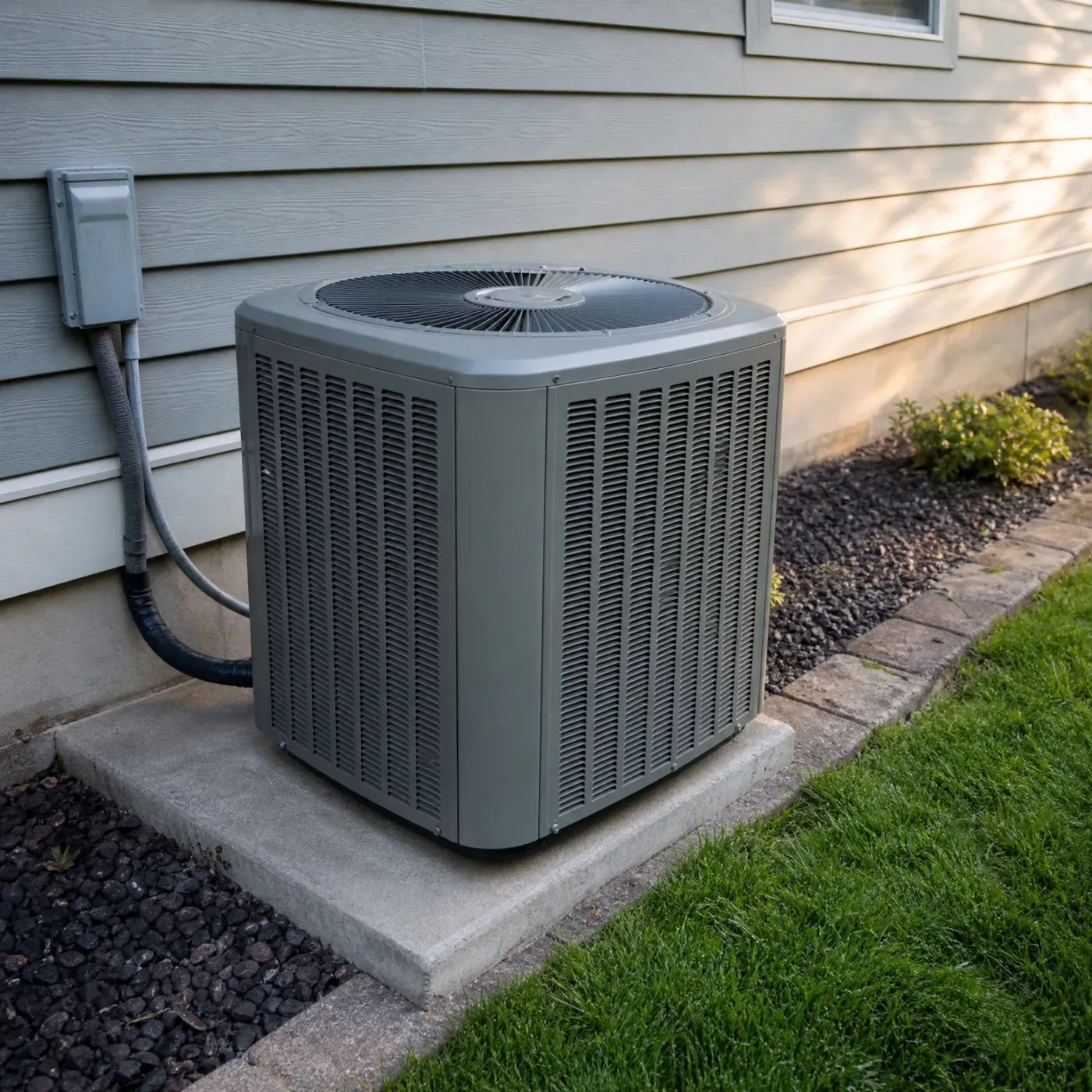
A dark gray outdoor air conditioner condenser unit on a concrete pad beside a house with horizontal siding and a plain light wall, with mulch and grass in the foreground and a conduit and electrical box on the wall.

A capacitor fails without warning

The compressor needs a jolt of extra current to start spinning, and a part called a run capacitor stores that charge. It sits inside the condenser and wears out from heat cycling, not age alone, so a unit that ran fine in June can fail outright in August. When it goes, the fan may still spin if you nudge it by hand, but the compressor itself stays dead until the capacitor is replaced.

A woman in a cream sweater and jeans stands in the open doorway of a white stucco house, holding the dark door, while a man in a dark quilted jacket seen from behind walks toward the entry past potted plants.

A dead compressor on a 90-degree day doesn't wait

When the compressor won't start, the rest of the system keeps running like nothing's wrong. The blower pushes air, the thermostat still lights up, so it's easy to assume the AC is working until you notice the air coming out isn't cold. By then the house has had hours to heat up, and with the humidity Massachusetts gets in July and August, a warm house feels a lot worse than the thermostat number suggests.

Leaving it alone costs you more than comfort. A compressor that hums but won't start, or clicks and shuts off, can trip its overload protection repeatedly, and that wears on it. Your electric bill matters here too, since Massachusetts rates are among the highest in the country, and a system straining to start draws more power than one that's working right. A local contractor who services this equipment every summer will know which of a handful of causes is likely yours, and reach out once you're matched to look at your actual unit.

A gray upholstered sofa with a matching cushion sits beside a potted plant and a wooden table holding a small green plant in a stone pot, near a curtained window.
A gray outdoor air conditioner condenser unit on a concrete pad beside a house with horizontal lap siding, with a flowering shrub at left and a disconnect box with conduit on the wall at right.

Running the way it should

The fan spins, you can hear a low hum, and the air coming out of your vents is actually cold. The disconnect box is seated and the pad underneath the unit is clear. This is what a condenser looks like when it's keeping up with a Massachusetts summer.


An outdoor air conditioner condenser unit on a concrete pad beside a house with light horizontal vinyl siding, surrounded by bare dirt, gravel and dry leaves, with refrigerant lines and conduit running along the wall.

Sitting idle in the heat

Leaves and dirt have piled up around the base and nothing inside is running. The refrigerant lines along the wall and the condenser coil behind them can't do their job if the unit never starts. Debris packed against the cabinet is sometimes part of why.

A man with grey hair and stubble in a dark sweater sits on a grey sofa indoors, looking off to the side, with a potted plant and a sunlit window behind him.
A man with gray hair, a beard and glasses, wearing a dark green sweater, sits on a gray sofa in a sunlit living room with a potted plant, table lamp and wooden sideboard behind him.
A middle-aged man with graying hair and a short beard sits on a blue sofa in a living room, looking toward a window, with a bookshelf, lamp and framed picture in the background.
A man with graying curly hair and a dark green sweater sits on a gray sofa in a sunlit living room, looking off to the side, with a framed picture, shelving, an armchair and a window with sheer curtains behind him.

Get the right pro for your air conditioner

A compressor that won't start is an electrical or mechanical fault, not something you can jump-start by resetting the thermostat a few more times. Capacitors weaken from running through every muggy stretch from June to September, contactors pit and stick, and a condenser that sat through a New England winter can have a connection that worked loose. Figuring out which one it is means pulling the panel off the unit with a meter in hand, not guessing from the thermostat. A licensed contractor working near you sees this same failure on local systems all summer and knows which part usually goes first on the equipment common to this area. That matters more here than in most places, since Massachusetts power rates are among the highest in the country, and a system drawing power without actually cooling costs you on the bill while you wait. One contractor gets your request, looks at your situation, and reaches out, instead of the problem sitting until a hot day turns into a hot week.

What's actually happening inside the unit

  • A capacitor stores a charge and gives the compressor the jolt it needs to start, and a weak one leaves it humming or silent.
  • The contactor is a small switch that closes to send power to the compressor, and pitted or burnt contacts stop that connection.
  • Compressors have an internal overload that trips and shuts the motor off if it draws too much current or runs too hot.
  • Low refrigerant charge makes the compressor work harder to build pressure, which can trip that overload before it fully starts.
  • A failed start relay or start winding means the motor gets power but never builds the torque to turn.
  • Years of summer humidity speed up corrosion on these electrical parts faster than a dry climate would.

Starting a compressor takes a specific sequence, and a break anywhere in it looks the same from outside: nothing happens. The thermostat calls for cooling, power reaches the outdoor unit, and from there a few parts have to do their job in order. The capacitor delivers a jolt of stored charge that gets the compressor motor turning. If it's weakened, the motor might hum under load without ever spinning, or it might not try at all. The contactor is the switch that lets power through to the compressor in the first place. Its contacts open and close every time the system cycles, and over thousands of cycles they pit, burn, or get stuck open. Even with good power and a good capacitor, a compressor has its own built-in protection, an overload switch that cuts the motor off if it's pulling too much current or running hotter than it should. Low refrigerant charge is one common way to trip that overload, since a compressor working against low pressure strains harder than it was built to. A failed start relay is another path to the same result: power gets to the motor, but it never gets the torque to turn over. None of these parts fail because of one bad day. They wear down over seasons of heat and humidity, and a Massachusetts summer puts all of them through a real workout from June into September.

A gray outdoor air conditioner condenser unit on a concrete pad beside a house with dark horizontal siding and a stone base, surrounded by gravel, with a flowering shrub at left and a concrete walkway in front.
Outside, the condenser sits clean on its pad, the disconnect box seated tight on the wall beside it.
An outdoor air conditioner condenser unit sits on a concrete pad beside a stucco wall, with refrigerant lines and conduit running to the wall and a shrub to the left.
This one's older, the fins caked with grime, and whatever's wrong inside is hidden behind that buildup.
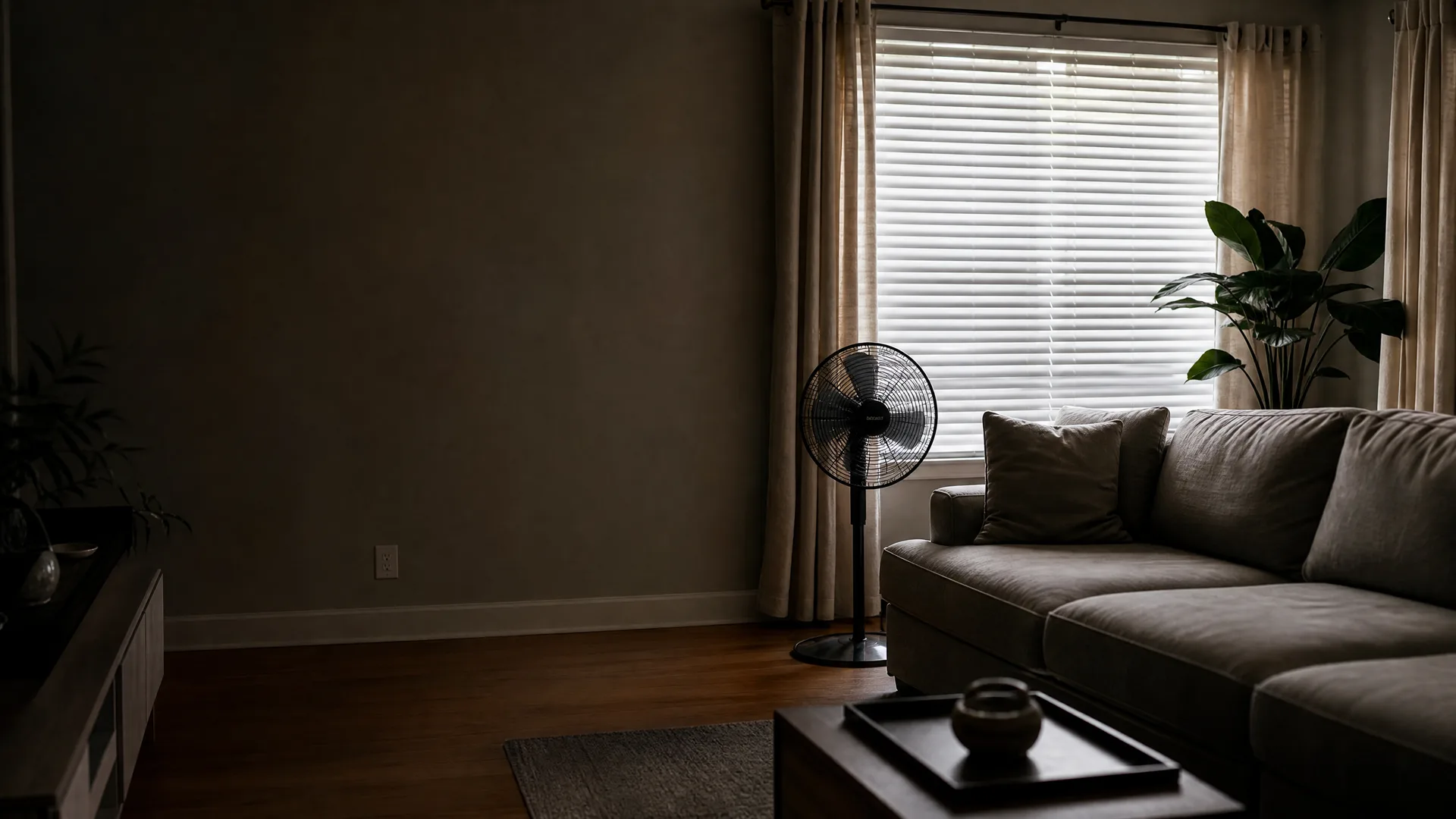
A dimly lit living room with a gray sectional sofa, a standing pedestal fan, a curtained window with blinds, a potted broad-leaved plant, a wooden coffee table with a tray and lidded jar, and a rug on dark wood flooring.

The blinds are drawn against the afternoon sun but the room is still warm. It's July, the middle of the day, and the floor fan next to the couch is doing the work the AC should be doing. You've checked the thermostat twice. It's set right, the display is lit, but the air coming through the vents is barely moving and nowhere near cold. Outside, the condenser sits silent. Another sticky Massachusetts afternoon, and the fan just pushes the same warm air around the room while you wait for someone to look at the unit outside.

Power costs 30.41 cents per kilowatt-hour statewide

At 30.41 cents per kilowatt-hour, a struggling compressor costs you more than a dead one. One that short-cycles or strains to start pulls extra power each time it tries, and that shows up on your bill before it quits for good.

EIA-861 2025 statewide residential average

  1. Thermostat calls for cooling and sends power to the contactor coil

  2. Contactor closes and sends power to the compressor and condenser fan

  3. Capacitor delivers a jolt that starts the compressor motor turning

  4. Compressor begins pumping refrigerant and the fan starts pulling air through the coil

A woman with shoulder-length brown hair wearing a beige knit cardigan sits in a gray upholstered armchair near a window, looking off to the side with a slight smile, with bookshelves blurred in the background.
A woman and a sleeping child wrapped together in a cream knitted blanket on a couch, with a potted plant, framed photo and lit lamp in the background.
A single-story house with gray vinyl siding, dark shingled gable roofs, and white-trimmed windows, set behind a partly dry green lawn under a clear blue sky.

A dew point of 60°F is the summer average for Massachusetts, according to NOAA climate data. That's the point where air starts to feel heavy and your AC has to pull more moisture out of the house before the house even feels cool. A compressor that's already weak, a tired capacitor or pitted contactor, has to work through that load every time it cycles on. On a dry 85-degree day it might limp along. On a sticky one it's more likely to strain, short-cycle, or just not start at all. If yours has gone quiet, this is the kind of stretch that finds the fault.

NASA POWER T2MDEW county cells weighted by homes

A compressor that won't start usually comes down to a bad capacitor, a stuck contactor, or a tripped disconnect, and none of those get fixed by waiting another day on a 90-degree afternoon. Someone who works on condensers all summer in Massachusetts has seen this exact failure more times than they can count, and knows which of those three to check first before the fins or the wiring even come into it. That's who gets matched to your call, one licensed contractor local to you, not a handful of companies competing for your callback. They'll come knowing the humidity here is what runs capacitors down in the first place, and they'll test for that rather than guess. You end up with one person who shows up knowing your equipment's usual failure points, not a stranger starting from zero.

A gray outdoor air conditioning condenser unit on a concrete pad beside a house with horizontal lap siding, with a wall-mounted disconnect box and conduit, lava rock mulch, a shrub, and grass nearby.

A pro who works on air conditioners

Reach a local pro

Only one pro gets your request, so you hear from one company.

No fee to send it, and nothing to sign.